Grace Bassett, reporter who chronicled urban legislation in Congress, dies at 93

A 1950s photo of Grace Bassett. (Richard Lyons/Courtesy of the family)
Grace Bassett, a journalist who covered District affairs on Capitol Hill for The Washington Post and the old Washington Star, most notably chronicling passage of the constitutional amendment giving D.C. residents a voice in presidential elections, died June 8 at a nursing home in Annandale, Va. She was 93.

The cause was complications from dementia, said her friend and power of attorney, Robin Renner.

Ms. Bassett worked at The Post from 1953 to 1957 and won a Washington Newspaper Guild Award for her coverage of the District’s response to the 1954 U.S. Supreme Court ruling Brown v. Board outlawing racial segregation in public schools.

At the Star, where she spent about a decade, her beat was urban legislation in Congress. The American Political Science Association honored her for excellence in political reporting for the two years she spent following the campaign for the 23rd Amendment to the U.S. Constitution. Ratified in 1961, it authorized D.C. residents to choose electors in presidential elections.

Attribution:  Adam Bernstein, washingtonpost.com

Full Story: Bassett

Joseph Volz - Journalist March 6, 1935 - May 23, 2020

Joseph Volz died Saturday, May 23, 2020, following a stroke complicated by diabetes; he was 85. He discovered his career as a journalist in high school while covering sports for the Newark daily newspaper. He'd like to say "I've shut down six newspapers," including the Washington Star.  In more than 30 years as an investigative journalist for the New York Daily News, Washington Star, Washington Daily News, and Newark News, Joe Volz covered everything from the police force to Watergate to the Pentagon. He ended his career as a columnist for the Copley News Service and the Frederick News-Post.  Joe was a Pulitzer Prize finalist with the New York Daily News for his reporting on military preparedness.  Joe was born in Newark, New Jersey on March 6, 1935. He graduated from Rutgers University. While awaiting his draft notice, he took a world tour visiting New Zealand, Australia, and Tahiti.

Attribution:Legacy.com
Full Story: Volz

Calvin Duffey Cramer - Printer April 29, 2020

LAKE WALES - Calvin Duffey Cramer of Lakeland, Fla., died April 29, 2020. He was 91.

Calvin was born in Washington, D.C., on June 26, 1928, the youngest of three boys (brothers Hugh H. Cramer 1920-1980 and Admiral Shannon Davenport Cramer, Jr. 1921-2012), to Shannon Davenport Cramer and Mary Eileen Hazen (née Duffey) Cramer.
He graduated in 1947 from Washington's Central High School, where he was class president and lettered in football, basketball and track.
After briefly attending Princeton University, Calvin returned to Washington and married his high school sweetheart, Carol Joanne Seaman in 1948. Starting as an apprentice, he worked in all aspects of the printing trade, including for Washington's Evening Star newspaper and in a small printing shop he ran with his best friend from high school. He played for the Union Printers basketball team in Washington's industrial leagues, and he and Carol were also youth leaders at St. Paul's United Methodist Church in Kensington, Md.
In 1963, Calvin took his printing skills to the U.S. Civil Service Commission. But dissatisfied with being a government bureaucrat, he made a leap of faith and took a job as director of Sky Lake United Methodist Church Camp in Windsor, N.Y., in 1970. For the next 20 years, he followed his passion for outdoor Christian education there and at other administrative positions in western and central Pennsylvania.

Attribution: legacy.com
Full story: Cramer

Peter Anthony Bozick, Sr. - White House Press Corp., February 24, 2020

Peter Anthony Bozick, Sr, age 94, died peacefully February 24, 2020 in Salisbury due to a fall the week before. He was an avid reader from an early age, largely self-taught, excelled in school and skipped two grade levels before high school. He graduated from Towson High School, while taking a night class at John Hopkins University. Being proficient in multiple languages, Pete enlisted during WWII and was placed into the Office of Strategic Services (OSS) and trainedas a spy. He was captured by the Nazis in the former Yugoslavia and rescued shortly thereafter by British forces. He was awarded a Purple Heart and the Distinguished Flying Cross for his service.

After the war, he attended the University of Maryland, where he met his wife Marilyn Scuderi. Before he and Marilyn were formally introduced, Pete memorably told his friend that he would "marry this girl". They married in 1949 for 65 years until her passing in 2014. Pete began a journalism career with Washington Evening Star newspaper, worked his way to news editor and was a member of the White House Press Corp.

Attribution: Legacy.com
Full Story: Bozick

Daniel Watkins Taylor - Gifted and Prodigious Writer and Photographer

Daniel Watkins Taylor, age 90, passed away on January 29, 2020, in Willow Street, Pennsylvania, where he resided for the past seven years. Born on July 3, 1929, in East Haven, Connecticut, he was the son of Robert Mitchell Taylor, MD, and Margaret Lyles Watkins Taylor. Daniel had a brother, Robert Mitchell Taylor II, late of Branford, Connecticut.

Daniel attended the Choate School, in the class of 1947, and went on to study English at Washington and Lee University, graduating in 1952. After college, he became a Lieutenant Junior Grade in the United States Navy, serving on the USS Delta and the USNS General John Pope during the Korean War. He was released from active duty in 1954.

A gifted and prodigious writer and photographer, Daniel began his career as a reporter on several newspapers from 1954-1959: The Times Herald Middletown, NY), the Hartford Courant (CT), and the Washington Evening Star (DC). He turned to public relations in 1959, when he began working for the Federal government in Washington, DC, as a public information consultant for the President's Committee on Scientists and Engineers (National Academy of Sciences), and then the Public Information Branch of the National Science Foundation, where his work included speech writing for the Director.

Attribution: lancasteronline.com
Full Story: Taylor

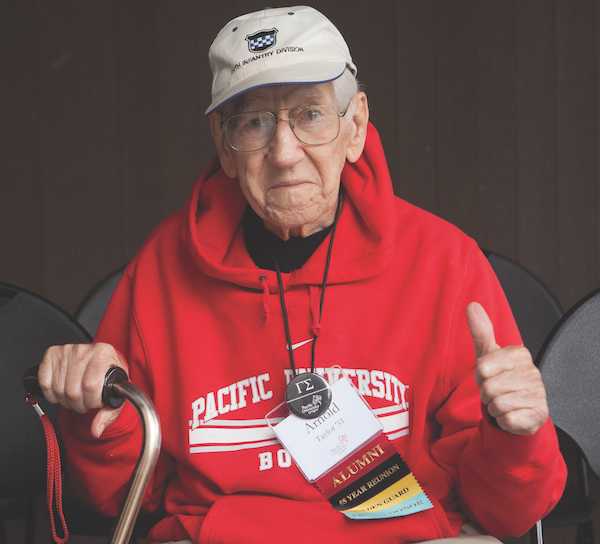
Banjos & Bibles: Arnold Taylor '51 Led a Colorful and Generous Life

Rev. Arnold G. Taylor ’51 spent four years on Pacific University’s campus, but he seemed to be present for much longer, even as his life took him to distant places and new callings.

Taylor, who died this spring at the age of 93, led a rich and interesting life before and after leaving Pacific. And throughout his life, he demonstrated his loyalty to his friends, to his ideals and to the university.

Before enrolling at Pacific, he was drafted into the Army in Providence, R.I., in August 1943, when he turned 18.

"What I had hoped for was to be an aviator. However, a quirk in my color perception disqualified me for that dream job,” he wrote in A Military History Narrative of Arnold Godfrey Taylor, a copy of which is in an office in Marsh Hall. “I asked if I could jump into the fight. One look at me and they laughed. I was a skinny kid, weighing only 120 lbs. One thought that if I were to jump out in a prevailing eastward wind that I would float into Berlin before anyone else — unless the parachute was weighted down with cannonballs, which may make for a loud landing and attract attention.”

Attribution: Mike Francis, www.pacificu.edu
Full Story:Taylor

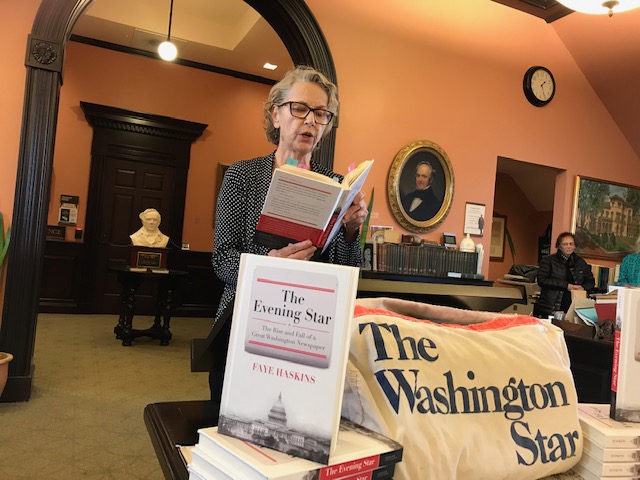
Star Alum Attend Faye Haskins Talk

From Joan Anderson

I went to Faye's talk at the Georgetown Library and it was quite good and well attended.

Here are a few photos from the talk.


Faye, during the reading,
Jack Kauffmann's son with Mike Mossetig and Joy Billington Doty in the foreground
Tom Crosby shaking hands with Joy
Harvey Kabaker and Abby Chapple

Tom Crosby shaking hands with Joy

Faye, during the reading

Jack Kauffmann's son with Mike Mossetig and Joy Billington Doty in the foreground
Harvey Kabaker and Abby Chapple


Merrill Brown - The News Project’s publishing platform goes live

CEO Merrill Brown  says he founded The News Project to address one of the big problems in the journalism business: “It costs too much to launch and operate news sites.”

It’s an issue that Brown knows well — he’s a former journalist, journalism executive and educator who served as the founding editor in chief of MSNBC.com. He announced earlier this year that The News Project has raised a six-figure investment from WordPress VIP, and now it’s actually launching with its first customer, the nonprofit site CALmatters, which offers news and analysis around California politics.

Last week, Brown and The News Project’s product lead Miguel Ferrer walked me through what the company does, both for CALmatters and more generally. The company’s pitch, in a nutshell, is to provide a “news business in a box.”

Ferrer explained, “Not only is it what you need for a news business in a box, it’s also understood to be more than a technical toolset, more than a CMS, even as the CMS is ultimately the core of everything.”

Put another way: The News Project has stitched together a publishing platform by working with a number of different partners, offering content management and hosting from WordPress  VIP, website development by 10up, reader engagement tools from Piano, design by Charming Robot and ads by Google Ad Manager. (TechCrunch works with a number of these companies, including WordPress VIP, 10up and Piano.)

Attribution:Anthony Ha, techcrunch.com
Full Story: The News Project

Faye Haskins Among 100 Authors At 2019 National Press Club Book Fair, Friday Nov. 1st

FYI: The new history of the Washington Evening Star newspaper is among the books included in the 2019 National Press Club Book Fair, As the author, I will be among the 100 authors to be at the Fair on Friday, Nov. 1 from 5:30-8:30.  For those living in the Washington metro area, please drop by if you can. Thanks.

Faye

 P.S. Reminder I will also be giving author talks at the Peabody Room, Georgetown Branch Library on 11/9 at 1pm; and at the Carnegie Library, Historical Society of Washington DC on 11/14 at 6pm.

Blog Note: Miriam Ottenberg entry update on Encyclopedia.com

Notification was received that an unspecified update was made to the entry

Miriam Ottenberg (1914 - 1982)
photo courtesy of geni.com
Miriam Ottenberg spent two years at Goucher College near Baltimore before transferring to the University of Wisconsin, where she received a B.A. in journalism in 1935. Her first job after college was writing copy for a Chicago advertising agency. A year later, Ottenberg became a reporter in the women's department for the now-defunct Akron Times-Press.

In 1937 Ottenberg joined the Evening Star, a Washington daily. Within her first two years on the job, she launched her first full-fledged newspaper investigation. She broke page one stories and exposés consistently over the years. By 1947 Ottenberg's specialization was the investigation of crime and the conditions fostering it. According to the Star, Ottenberg probed "phony marriage counselors, a multi-state abortion ring, high food prices, juvenile crime, sex psychopaths and dope addicts." In 1958 the Washington law enforcement community honored Ottenberg with a testimonial reception and a plaque crediting her contributions.


Attribution: encyclopedia.com
Full story: Ottenberg

Genevieve Nadig, Meet the Mother of New Hampshire's Midnight Voting Tradition

A personal cartoon given to Genevieve by
Clifford K. Berryman of The Washington Star.
CREDIT COURTESY OF THE NADIG FAMILY ARCHIVE
If you follow New Hampshire politics, you’re probably familiar with the ritual of the midnight vote, where a handful of tiny, mostly rural towns stay up late to cast their ballots as soon as election day dawns.

And you would be forgiven for thinking all the credit for this tradition goes to Neil Tillotson, the bespectacled businessman who was so well known as the face of Dixville Notch’s nocturnal vote that he’s honored with his very own bobblehead at the New Hampshire Historical Society gift shop, complete with a ballot box and all.

But New Hampshire’s midnight voting tradition didn’t actually start in Dixville — or with Tillotson. Instead, according to the earliest public record we could find, it started a few miles away, and a few decades earlier, with a 27-year-old woman named Genevieve Nadig.

She was a faithful Republican who delighted in meeting Presidents Nixon and Reagan. Clifford K. Berryman, a famous political cartoonist for The Washington Evening Star, was so enamored after visiting Genevieve he sent her a personalized drawing depicting two stuffed pillows he picked up from her roadside gift shop. That piece still hangs on Rick’s wall today.

“Everybody loved Genevieve,” Rick says. “Everybody.”

Up until the week she died in 1985, Rick says his aunt was still skipping around, vibrant as ever — probably because a tourist just stopped by her shop with a $100 bill.

Attribution: Casey McDermott, nhpr.org
Full Story: Midnight Vote

Faye Haskins Book Reading Schedule, "The Evening Star: The Rise and Fall of a Great Washington Newspaper”

For much of its life, the newspaper you are holding in your hands — or perusing on your computer or smartphone — was nowhere near the best one in Washington. It wasn’t The Washington Post that was thick with ads, peppered with datelines from around the world, full of insider gossip, piercing editorial cartoons and the proclamations of officialdom. It was the Washington Evening Star.

The life of every star is finite, and Washington’s Star was no different. On Aug. 7, 1981, the words “FINAL EDITION” blared from above the paper’s nameplate. It really was.

The life of the paper is recounted in “The Evening Star: The Rise and Fall of a Great Washington Newspaper,” a new book by Faye Haskins, a former archivist and photo librarian in the D.C. Public Library’s Washingtoniana division.

Haskins will be speaking about her book at 1 p.m. Nov. 9 in the Peabody Room at the Georgetown Neighborhood Library and at 6 p.m. Nov. 14 at the Historical Society of Washington in the Carnegie Library.

Attribution: John Kelly, washingtonpost.com
Full story: Haskins

OPINION - Despite TIMEly Death, Washington Star Spared NYTimes Shame, Humiliation, Downfall


Kavanaugh's Accuser Max Stier Is Former Clinton Lawyer
“If at first you don’t succeed… try, try again… at least as long as the internet traffic and potential book sales from frustrated liberals continue to hold.”

After this past weekend’s bogus “bombshell” about Supreme Court Justice Brett Kavanaugh, perhaps that line should replace “All the news that is fit to print” as the new motto of the now further diminished and increasingly liberal New York Times.

The once universally respected paper of record published a bizarre opinion piece on a book by two of its reporters who investigated Kavanaugh’s past, in light of the sexual assault allegations levied against him during his intensely contentious confirmation process. The piece, which is weirdly headlined and framed as a look at the Yale University culture at the time Kavanaugh studied there, eventually reveals a “new” allegation against him. It sounds very similar to the one involving Deborah Ramirez, which the authors try mightily to resuscitate, mostly through the use of smoke and mirrors.

The story has been the talk of the internet for the past two days and its “revelations” have been widely copied and pasted by other major news outlets. However, there is absolutely nothing “new” or legitimately credible in the piece, and there are key omissions that should humiliate the Times and, in a rational world, would never have allowed the story to run as it did.

The “second” Yale allegation comes in the form of a male witness, Max Stier, who some 35 years later told investigators during Kavanaugh’s confirmation hearings that he saw the nominee put his genitals in the face of a woman on campus (importantly, Democrats in the Senate decided not to do anything with this account). There are massive problems with this allegation, however, and how the Times allowed their biased reporters to frame it.

First, according to the reporters’ own book, the alleged victim has no memory of Kavanaugh doing this to her, and yet their article does not make that at all clear. Right there, especially since the information is not new, this accusation should never have been in the Times story. (An update was added to the Times piece late Sunday night noting that the alleged victim “declined to be interviewed and friends say that she does not recall the incident.”)

Responsible journalists simply cannot allow such an explosive claim against a highly politicized figure to be levied such an incredibly long time after the alleged event when there is no known victim, and absolutely no contemporaneous account of it happening. But this is still not the worst offense against journalism in the piece.

Steir is hilariously described as a “thought-leader” who works for a D.C. non-profit. The liberal media activists on Twitter — including Ronan Farrow and Jane Mayer who first, dubiously, reported on the Ramirez episode after the Christine Ford allegation became public — gushed all over him as someone whose reputation makes him a stellar witness.

Attribution: John Ziegler, mediaite.com
Full Story: Tantrum

In $180M Deal, TIAA-CREF Takes Washington’s Evening Star Building

The nation’s capital continues to draw eager office buyers. On Wednesday, the giant institutional investor TIAA-CREF closed on the $180 million acquisition of the Evening Star building from KanAm Grund, the Frankfurt-based investment manager, sources familiar with the deal confirmed today.

Located at 1101 Pennsylvania Avenue NW, a few blocks from the White House and the National Mall, the fully leased 225,501-square-foot office property (pictured) was the long-time home of the newspaper known most recently as the Washington Star. The building was the newspaper’s  home when it went out of business in 1981. Tenants include Citigroup Inc., International Paper Co., the Federal Bureau of Investigation, and TIAA-CREF itself.

The building’s price is among the highest paid for an office property in Washington, D.C., this year, even though it hardly ranks among the city’s newest office assets. Built in 1898, the Evening Star building is said to be the second-oldest building on Pennsylvania Avenue after the White House. In 1989, the property underwent expansion and renovation.

Attribution: Paul Rosta, cpexecutive.com/
Full story: Deal

Looking for an experimental modern mystery to read at the beach?  Amazon yesterday published an e-book (Kindle) and paperback from Star alumnus Bill Grigg called A PERFECTLY NATURAL MURDER.
It is uniquely told by three participants, a raunchy ex-Marine with post-traumatic stress disorder, a witty woman lawyer — and the dead victim!   It is set in a  insurance company, and Bill reports many of its ideas stem from his late wife, Martha Livdahl, who was the  director of employee publications at GEICO..  (Martha also worked at The Star.  In the book, the discovery of fraud leads to a nearly perfect, "green" murder for which the ex-Marine and the lawyer get blamed, battered and targeted for death themselves.  The imperfect  hero is trying to clean up his car but says, “Give me some slack, please!  It’s not like you never heard the word before!”
You can read a free sample of  A PERFECTLY NATURAL MURDER by Googling  Amazon books, putting in the book’s name and then  clicking on the book’s cover., If you read the book and like it, please leave a review on Amazo, as positive reviews spur sales!
Bill was The Star’s medical writer, covered the Senate and then was press aide and chef of staff for Congressmen Gilbert Gude and Newton Steers.

They begged Frank Lloyd Wright to build them a house they couldn’t afford

The Pope-Leighey House.
(Carol M. Highsmith/Library of Congress)
Not far from the Pentagon in Northern Virginia, there is a small house nestled into a woodsy and green background — the kind of serene setting you’d imagine on a postcard.

Designed by Frank Lloyd Wright, the Pope-Leighey House, as it’s known in architectural circles, is a single-story home with a history both odd and a little sad.

While not nearly as famous as Wright masterpieces such as Fallingwater and the Solomon R. Guggenheim Museum, the story of the home is a remarkable, revealing tale that foreshadowed how many Americans live today.

It begins with a journalist at a now-defunct newspaper.

His name was Loren Pope.

In the 1930s, Pope was a copy editor at the Washington Evening Star.

“He’s making $50 a week,” said Peter Christensen, a longtime tour guide at the Pope-Leighey home.

That’s certainly not enough to afford a Frank Lloyd Wright house — at least the ones he had been designing at the time, which would run about $650,000 in today’s dollars.

But in 1938, Pope saw Wright on the cover of Time magazine. The splashy story inside was a celebration of Wright nearly completing Fallingwater, a summer mansion in rural Pennsylvania built over a waterfall.

In passing, the article also mentioned that Wright wanted to create Usonian-style homes for middle-class, regular folks — people such as Pope and his wife.

The couple, as it happened, were in the market for a home. They had just bought a plot of land in Falls Church, Va. Pope wasn’t sure what style of house he wanted to build there. Maybe a classic Cape Cod with a white picket fence.

“Loren reads the article. He is smitten,” Christensen said. “He no longer wants that Cape Cod. He wants something more interesting.”

He wants a Frank Lloyd Wright home. Then, he lobbied the architect to build him one, appealing to Wright’s extraordinary ego.

Attribution - Michael S. Rosenwald, washingtonpost.com
Full Story> Pope-Leighey House

Diane Woolley Bauer, Investigative Reporter, 1932- 2019

She was a muck-raking investigative reporter, a cab driver, a U. S. Senate press aide, a merchant seaman, and a mother of four who served on Berkeley's Waterfront Commission as well as two terms on the Berkeley City Council. She was briefly hospitalized, and died surrounded by family on June 7th, 2019 after a few years of declining health. She leaves a legacy of extraordinary work both as a journalist and as a Berkeley councilmember dedicated to serving District 5's neighborhoods.

Diane Woolley Bauer's father was a writer with MGM in Los Angeles, where she was born, but had been a commander in the British Royal Navy who served in World War I. He was called back for World War II and stationed in Jamaica, where Diane spent a portion of her young life. After the war the family moved to Washington D.C. where during her college years Diane took a two-week job as a vacation replacement for what was then called a copy girl at the Washington Post and her career as an investigative reporter began.

She became the youngest reporter in Washington D.C. Then-owner of the Post, Eugene Meyer, set aside the rule requiring that reporters have a college degree to put Bauer in charge of what is now called the Style section of the Post covering "politicians, diplomats and debutantes", as she put it, doing the layout and writing an advice column for college girls under her picture and byline. It should go without saying that women were an uncommon part of such workplaces.

She continued to work part-time as a young wife and mother writing ad copy, serving as a U.S. Senate press aide and a campaign director, but excelled as a self-taught journalist. She is credited for doubling the Washington Daily News' Maryland circulation with her hard-driving public interest stories, often scooping the full-timer reporters at the Washington Post and Evening Star. When the Daily News folded into the Evening Star she was one of the few reporters who were kept on. She wrote, investigated, and consulted for public interest research and law firms working special assignments for Newsweek, CBS television, panels, and documentaries such as ABC's "The Paper Prison" specializing in courts, police and prisons, juvenile detention, privacy and records-keeping, and medical ethics. One of her pieces on juvenile offenders' treatment provoked a letter from J. Edgar Hoover defending the FBI's procedures; she kept the letter.

Her work was so thorough it is cited in several books on civil liberties, behavior modification, privacy, and bioethics as well as some Supreme Court cases. Her writing is credited for playing a role in highlighting atrocities and instituting reforms at Maryland's infamous Patuxent Institution where she revealed an expensive behavior modification scandal. Author Nat Hentoff wrote a story about her tireless investigative journalism, including the illumination of "a hitherto hidden plan...to form a secret intelligence unit to combat organized crime" which her writing revealed arranged to violate, among other things, privacy laws. The unit had to be scrapped.

Attribution: Carol Denney, berkeleydailyplanet.com
Full Story:  Bauer

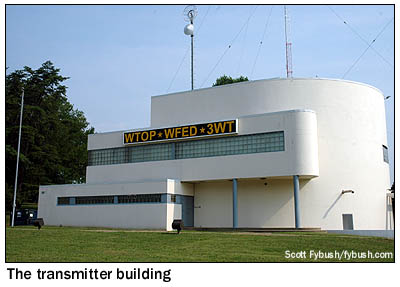
‘You turn us on and we’re there’: Looking back at 50 years of news on WTOP

2019 audiences have a seemingly insatiable appetite for news on the radio (and on TV and online), but the listeners of 1969 weren’t buying all-news radio early on.

“Most of my mail reflects dissatisfaction with WTOP’s all-news and information format,” wrote Bernie Harrison, TV critic for the Washington Star, days after the switch.

Yet there was promise. About a week later, Harrison saw a “revolutionary” quality to it all: “After 12 staggered hours of listening to WTOP’s new 24-hour nonstop news operation, however, I’m impressed but not precisely bewitched by the phlegmatic performance,” he wrote.

Uh … thanks?

While the station has focused its programming on news for 50 years, it’s only fair to point out there have been diversions. There was a time when WTOP carried the great Larry King’s overnight talk show, and there was some weekend and sports programming.

Attribution: Jack Pointer, wtop.com
Full Story: WTOP

Faye Haskins New Book - The Evening Star: The Rise and Fall of a Great Washington Newspaper

The Evening Star: The Rise and Fall of a Great Washington Newspaper is the story of the 129-year history of one of the preeminent newspapers in journalism history when city newspapers across the country were at the height of their power and influence. The Star was the most financially successful newspaper in the Capital and among the top ten in the country until its decline in the 1970s. The paper began in 1852 when the capital city was a backwater southern town. The Star’s success over the next century was due to its singular devotion to local news, its many respected journalists, and the historic times in which it was published. The book provides a unique perspective on more than a century of local, national and international history.

The book also exposes the complex reasons for the Star’s rise and fall from dominance in Washington’s newspaper market. The Noyes and Kauffmann families who owned and operated the Star for a century play an important role in that story. Patriarch Crosby Noyes’ life and legacy is the most fascinating –a classic Horatio Alger story of the illegitimate son of a Maine farmer who by the time of his death was a respected newspaper publisher and member of Washington’s influential elite. In 1974 his descendants sold the once-great newspaper Noyes built to Joseph Allbritton. Allbritton and then Time, Inc. tried to save the Star but failed.

Attribution: Faye Haskins, rowman.com
Full Story & order: Haskins

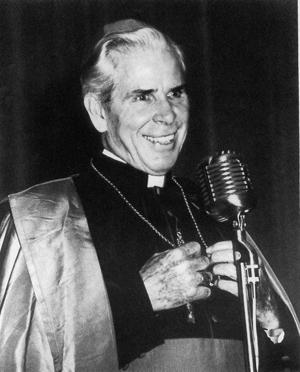
Caboose Added To Sheen Museum In El Paso

The museum contains several of the hundreds of books and articles Sheen authored. There also are copies of magazines which featured articles about him throughout his lifetime, and audio and video tapes of his talks are available for listening and viewing.
Copies of handwritten and typed manuscripts from the Sheen Archives in New York also are at featured along with copies of radio talks from the "Catholic Hour" and newspaper articles from the Washington Star syndicated column "Bishop Sheen Writes."
Attribution: Kevin Barlow, pantagraph.com
Full Story: Sheen